Exercise 2: Preparation of pH Indicators from Anthocyanins
In this experiment, you will extract the anthocyanin pigment from red cabbage to create pH strips. It is recommended that you wear old clothes or an apron since the dye from the cabbage will stain so be careful to not damage your clothing or carpet!
PROCEDURE:
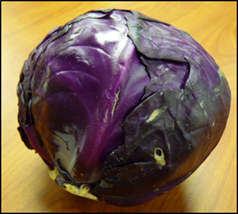
1. Remove the outer leaves of the red cabbage.
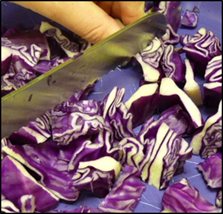
2. Place the red cabbage on the cutting board. Using a knife, chop the cabbage into pieces, as shown in Figure 7.
Figure 7 — Chopping your cabbage
3. Using a measuring cup, measure 1 cup of tap water.
4. Bring the cup of tap water to a boil. You can microwave it in a heat-safe bowl, boil it in a pot on the stove, or boil it in a tea kettle.
5. When the water reaches a boil, use an oven mitt to hold the container, and (if it is not already in a heat-safe bowl) carefully transfer the boiling water into a heat-safe bowl.
6. Add 1 cup of chopped red cabbage into the heat-safe bowl of boiling water.
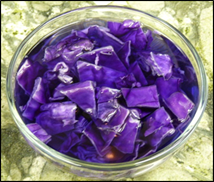
7. Use a spoon to ensure that the red cabbage is fully immersed in the water, as shown in Figure 8.
Figure 8 — Steeping your cabbage
8. Allow the red cabbage to steep in the water for 20 minutes.
NOTE: This is not the "incubation time" for this exercise.
9. After the red cabbage has steeped in the water for 20 minutes, use the spoon to mix the cabbage and water. This will allow the deep purple color to be evenly distributed throughout the bowl.
NOTE: This dye will stain so be careful to not damage your clothing or carpet!
10. Use two coffee filters and cut the bottoms (flat part) out. Cut the two round bottoms from the coffee filter in half. You should now have 4 pieecs.
11. Submerge one cut piece of filter paper into the bowl of red cabbage and water. The filter paper must be fully submerged in the bowl, as shown in Figure 9. Allow the filter paper to absorb the colored water for 5 minutes.
Figure 9— Dyeing your filter paper
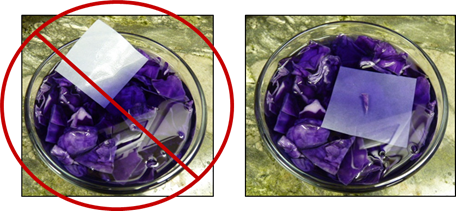
12. After 5 minutes, remove the filter paper from the bowl and place it flat on a plate or tray and allow the paper to begin drying
13. Repeat Steps 11 and 12 for the remaining three cut pieces of filter paper.
14. Remove the cabbage from the bowl and dispose of it in the trash. Pour the colored water down the drain. Wash and dry the bowl.
15. Allow the filter paper to dry for approximately 4 hours before proceeding on to the next step.
NOTE: This is the "incubation time" for this exercise.
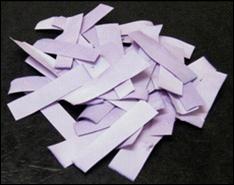
16. When the filter paper is dry, cut the paper into strips, approximately 0.5 cm wide. The length will vary since the one side is a curve. See Figure 10.
Figure 10
— Strips of homemade pH paper
17. Place the cut filter paper aside for use in Exercise 3. These cut filter papers will be referred to as "Homemade pH paper" for the remainder of this lab |