Exercise 1: Water and its Special Traits
In this exercise, you will investigate the properties of cohesion and adhesion in water. You will demonstrate how these properties work together to create surface tension and capillary action.
PROCEDURE:
Part 1
- Fill a cup with tap water so that the cup is almost full.
- Hold a needle vertically, as close to the water in the cup as possible without actually touching the needle to the water.
- Gently drop the needle onto the water.
- Record the observations in Data Table 1, column "Vertical."
- Carefully retrieve the needle from the water and dry it.
NOTE: The needle must be completely dry between each step. If you would like to repeat any steps, make sure to dry the needle before you begin.
- Hold the needle horizontally, as close to the water in the cup as possible without actually touching the water.
- Gently place the needle onto the water.
NOTE: Do not drop the needle at an angle.
- Record the observations Data Table 1, column "Horizontal."
- Drain the water from the cup and dry both the cup and needle.
Data Table 1 – Needle Observations
| Observations |
Vertical: |
Horizontal: |
|
|
Part 2
- Place a paper towel on a flat surface.
- Place the 2 oz.– 8 oz. cup or drinking glass on the paper towel.
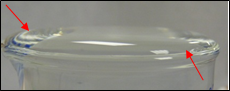
- Fill the cup or drinking glass just above the brim with tap water without allowing the water to overflow. See Figure 5.
Figure 5 – Water filled just above brim
- Estimate how many paper clips can be added to the cup before the water overflows. Record the estimation in Data Table 2, column "Hypothesis."
- Add paper clips to the cup one at a time while counting the number added. The paper clips will sink to the bottom of the cup. Add paper clips until the surface tension breaks and water spills over the cup.
- Record the results in Data Table 2, column "Result."
Data Table 2 – Paper clips needed to beak surface tension
| Hypothesis: |
Result: |
_____ Paper clips |
_____ Paper clips |
- Drain the water from the cup or glass and then dry both the cup or glass and paper clips.
Part 3
1. Place a paper towel on a flat surface.
2. Place a coin of any type on the paper towel. Ensure that the coin is level.
3. Fill a pipet with tap water.
4. Estimate how many drops of water you think can be placed on the coin before the surface tension of the water will break and the water will flow off the face of the coin. Record your hypothesis in Data Table 3, column "hypothesis."
5. Using the pipet, place one drop of water at a time onto the coin until the water flows over the face of the coin. Count the drops as they are added and record the final number of drops in Data Table 3, column "results."
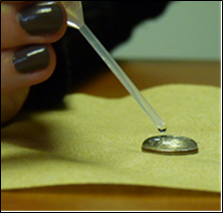
Figure 6 – Coin demonstration and proper hand placement
Data Table 3 – Drops of water
| Hypothesis: |
Result: |
_____ Drops of water |
_____ Drops of water |
6. Dry the coin and remove the water from the pipet. Keep the pipet for use in the Exercise 3.
Part 4
- Obtain one celery stalk with leaves or white carnation flower.
- Cut the end of the celery or flower stem on a diagonal.
- Fill a drinking glass with 0.5 cups of tap water.
- Add the 1 mL of food coloring.
- Cut the end of the celery stalk or flower, and immediately place it into the colored water.
- Allow the celery or flower to incubate in the colored water for 4 hours.
NOTE: If you do not see any change in the celery or flower after 4 hours allow the incubation time to continue.
- When the incubation time is complete, observe the celery or flower. Record your observations in Data Table 4.
Data Table 4 – Part IV observations
|