Exercise 2: Measurements of Volume
The basic unit of measure for volume is the liter (L), which is equal to 1.0567 quarts. One liter is also equal to 1000 milliliters (mL), which is sometimes referred to as cubic centimeters (cm3), as one milliliter is equal to one cubic centimeter.
In scientific labs, graduated cylinders and pipettes are used for measuring volume. There are many different varieties of pipettes. In research laboratories, pipettes are precise enough to measure microliters (uL). In this exercise, a graduated Pasteur pipet will be used. A Pasteur pipet is typically used to transfer small volumes of water from one container to another, but is not considered a precise unit of measure.
PROCEDURE
1. Fill the beaker (if you have one) or fill a one (1) cup measuring cup 3/4 full with tap water.
2. Carefully pour and measure 25 mL of water from the beaker / measuring cup into graduated cylinder.
NOTE: In a glass graduated cylinder, the water level should always be read from the bottom of the meniscus. The meniscus is the concave shape that forms when water adheres to the side of a glass surface. See Figure 4 for proper meniscus measuring in a glass graduated cylinder.
NOTE: In this experiment, a measuring cup may be used instead of the beaker, and a meniscus reading will not be used if you are using the one (1) cup measuring cup.
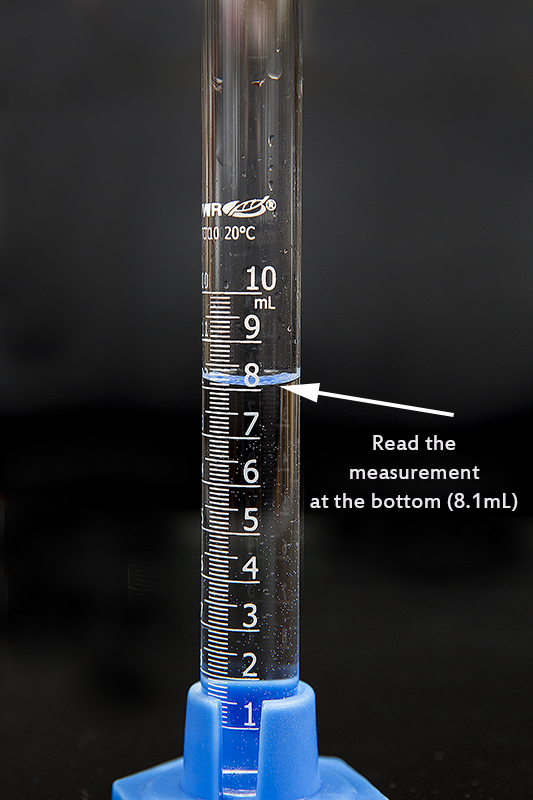
Figure 4 – Glass graduated cylinder showing a meniscus. In a glass graduated cylinder, the volume should be read from the bottom, not the top, of the meniscus.
3. Practice filling the graduated cylincer to different volumes.
4. When you have finished taking measurements, empty both the graduated cylinder and the glass and dry them.
5. Fill the measruing cup about half way or the beaker with approximately 50 mL of water.
6. Use the pipet to pull up water from the beaker.
NOTE: To fill the pipet, squeeze the bulb of the pipet to push the air out before placing it into the beaker of water. Once the tip of the pipet is in the water, release the bulb of the pipet and it will pull water up into it
7. Use the pipet to transfer exactly 1 mL of water into the graduated cylinder. Count the drops as they are added and record the number of drops needed to measure 1 mL of water. ____________________.
8. Use the pipet to transfer an additional 14 mL of water into the graduated cylinder, so that the graduated cylinder contains exactly 15 mL total of water. Record this volume in Data Table 1, next to "initial."
NOTE: In this exercise you will measure the volume of an object using water displacement.
9. Take an object—such as a marble—that it is small enough to fit into the graduated cylinder and place it into the graduated cylinder while tilting the cylinder on its side, to prevent splashing.
10. Measure the new volume of water in the graduated cylinder. Record this volume in Data Table 1, next to "with object."
11. Subtract the volume in next to "with object" from the volume next to "initial." This difference in volume is equal to the volume of the object. Record the volume of the object below Data Table 1.
Data Table 1 – Water volume measurements.
| |
Volume of water in graduated cylinder (mL) |
Initial |
|
With object |
|
Volume of object (mL) = __________________________
12. When you have finished the experiment, pour the water down the drain. Clean and dry all lab equipment and return to your lab box for future use. |