Discussion and Review
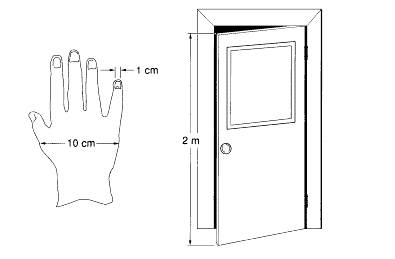
In scientific investigations, accurate and precise measurements must be used to ensure the validity of data. In the majority of scientific areas of study, the metric system is used. In Figure 1, familiar objects are shown with metric measurements. The International System of Units (SI), established in 1960, is the current version of the metric system.
Figure 1 – Relative size comparisons between two familiar objects using the metric system
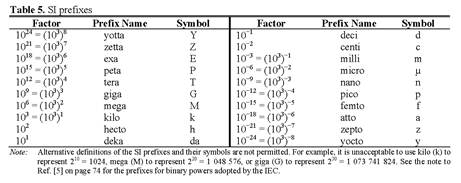
The goal of the metric system was to produce a system that used the same set of standards, and the decimal system. When measuring very large or very small objects, it was easier to use the decimal system than introduce new units of measure. Each unit in the decimal system has a specific prefix to use when describing a measurement. See Figure 2 for a depiction of units of measure within the metric system.
Figure 2 – Prefixes for units of measure
The SI measuring system is a system based on units of 10. Conversions are simple because they only involve moving the decimal to the right or to the left. When moving from small units to larger units, the decimal is moved to the left. When moving from large to small units, the decimal is moved to the right. In Figure 3, an easy stair-step system is used to convert units. Each "step" in the stair-step system is a movement of one decimal place. When going up the "stairs," the decimal is moved to the left. When going down the stairs, the decimal is moved the right. Meters, liters, and grams (m l g), which represent length, volume, and mass, respectively, are base measurement units.
Figure 3 – Metric Conversion Guide.
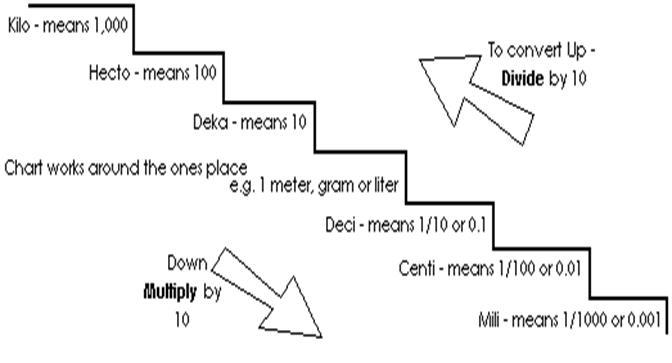
You use this chart to convert metric measurements like this:
- If you are measuring length use meter, then just add the appropriate prefix above.
- If you are measuring dry weight use grams, then just add the appropriate prefix above.
- If you are measuring liquid capacity use liter, then just add the appropriate prefix above.
The metric system is used to measure:
Length – Linear distance measured in meters.
Volume – Amount of space occupied by matter measured in liters. It is most commonly used in measuring liquids but can also be used to measure solids and gases.
Mass – Amount of matter in an object measured in grams, and, under standard atmospheric conditions, is equivalent to weight.
Temperature – This is the degree of kinetic energy in a substance, which is measured as temperature. The SI units are Kelvin but degrees Celsius are commonly used.
|