Heart Physiology
Review the safety materials and wear goggles when working with chemicals. Read the entire exercise before beginning. Take time to organize the materials needed and set aside a safe work space in which to complete the exercise
Objectives
- To describe the pressure changes which occur during a cardiac cycle,
- To describe the steps in determining blood pressure,
- To define pulse and take a pulse reading in several locations on the body,
Materials |
Qty |
Item Description: |
|
1 |
Human Biology Textbook for reference |
|
1 |
A partner or family member to perform some of the activities |
|
1 |
Access to a grocery store/pharmacy automatic blood pressure monitor OR personal blood pressure monitor |
|
1 |
Stopwatch (some way to record time to the second) |
Introduction
Before you begin these exercises it is important to review the anatomical features of the heart and how blood flows through its four chambers. Refer to Heart Anatomy Review, Heart Anatomy Review 2 or your Human Biology textbook for a review of heart anatomy.
One complete heartbeat is called a cardiac cycle. During a cardiac cycle, each atrium contracts and relaxes once and each ventricle contracts and relaxes once. The contraction of a chamber is called systole (sis-toe-lee). The relaxation phase is called diastole (di-as-toe-lee). The average human heart has between 70 and 75 cardiac cycles (heartbeats) per minute. Each cycle lasts just under 1 second.
The diagram below shows the stages of a complete cardiac cycle.
In this exercise you will apply the steps of the cardiac cycle to explore blood pressure, pulse and heart rhythms through the study of electrocardiographs.
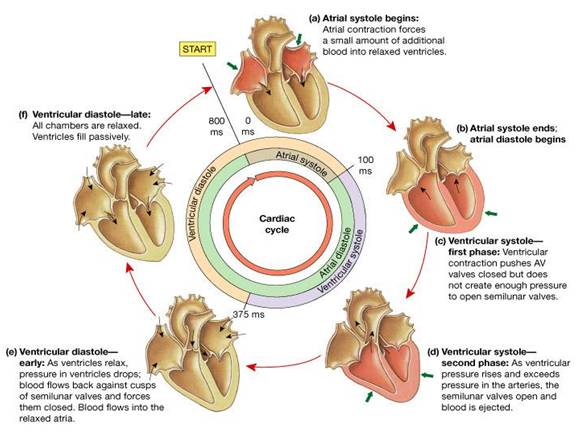
(Image courtesy of The National Library of Medicine. http://www.nih.nlm.org)
|