Posterior Muscles
There are several muscles that will be covered for the posterior (back) of the human body. For all the following muscles reference Figure 3 and your body.
- Deltoid - this is a superficial muscle that encompasses the anterior, lateral and posterior sides of the upper 1/3 of the upper arm. It can easily be palpated by placing a hand on the most upper portion of the arm and raising that arm away from you in a sideways motion. If you add some weight to the hand you are lifting you will feel the deltoid contract more.
- Trapezius - this is a very large superficial muscle. It is found on your upper back but also the portion of muscle in the diagram below tha tis just above the labeled portion and running into the neck. You can palpate the superior (upper) portion by placing your hand on your shoulder right where it meets your neck and elevate your shoulder (shrug your shoulder).
- Triceps Brachi - larger muscle that is partially superficial and partically deep. It serves as the antagonist to Biceps Brachii. To palpate, place your hand on the posterior (back) of your upper arm and place the back of your hand on a solid surface. Try and push your hand through the surface without allowing the elbow to bend. The Triceps Brachii will buldge and contract.
- Latissimus Dorsi - very broad and large superficial muscle of the lower back. To palpate you need to place a hand a couple inches below your armpit on the lateral side of your ribs. (Find a chair with a solid back or a wall for this part.) Then you will need to push your bent elbow into the chair / wall. This force of pushing the arm backwards will cause the Latissimus Dorsi to contrct.
- Gluteus Maximus - this is the large, superficial muscle of your behind. To palpate you will need to stand up and extend your entire leg backwards. You can feel the contraction of the muscle through your entire behind but it is easiest to palpate just below the coxal bone ('hip bone') on the posterior side of your pelvis. The motion of streching your entire leg backwards (extending your leg) will contract the Gluteus Maximus.
- Hamstring Group - a grouping of three muscles on the posterior side of your upper leg. To palpate place a hand anywhere between your behind and back of your knee and then, while standing, bend your knee so you are standing on one leg with one knee bending towards 90 degrees.
- Gastrocnemius - the largest superficial muscle of your posterior lower leg (calf). This muscle may look like two but it really is only one muscle with two muscle bellies. To palpate place a hand on the posterior portion of the lower leg and point your toes away from your body. You can feel the muscle contract a bit more by standing on your toes.
- Achilles Tendon - this is not a muscle but connective tissue (dense regular connective tissue) that connects the Gastrocnemius and Soleus muscles to the heel (calcaneal bone). You can palpate this tendon when the Gastrocnemius muscle is contracting as stated above.
Figure 3 - Muscle Man Posterior
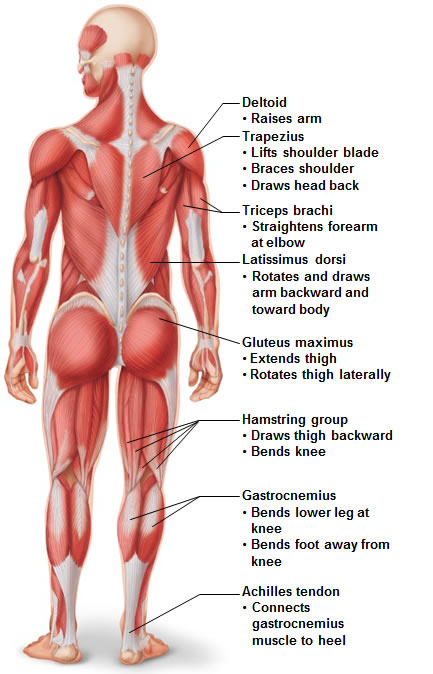
Image from Johnson Human Biology 6th edition.
|
|