In this lab you will be identifying some of the major muscles of the human body. The muscles will be identified through your book, this lab and your own body. You will also refresh your memory on muscular histology.
Gross anatomy is the study of various structures of the human body. The muscular system works as one unit with the skeleton to provide structure, support, and locomotion for the body. Every muscle in the body needs other muscles in the body to work. The muscles on depend on other muscles to accomplish their functions.
In order to understand muscles, a few terms must be introduced. All muscles are attached to a bone or another muscle through connective tissues such as tendons (muscle connected to bone - rope like) or aponeuroses (muscle connected to muscle - sheet of connective tissue). The origin of a muscle is its stationary end or attachment. The insertion of a muscle is the movable end. Take the example of figure 1 below. The muscle labeled 1 is the Biceps Brachii. You can see the ends of the muscle are in the elbow and shoulder. Which is the origin? Which is the insertion? Test you answers by flexing your arm (show off your muscle like the diagram). Where did movement occur, by the elbow or shoulder? The only movement should have been by the elbow, your forearm should have moved. This means the origin is the shoulder (it didn't move) and he inssertion is the elbow (it did move).
Muscles work through CONTRACTION ONLY. However, depending on how muscles are positioned, they may affect flexion and extension of a body part. For example, the biceps brachii originates in the shoulder region and inserts into the elbow region. See Figure 1. The action of the muscle is the movement it performs. Flexion is the movement in which the angle between body segments (upper arm and forearm) decreases, and extension is the movement of the muscle in which the angle between the segments increases. The biceps brachii performs flexion of the elbow.
Figure 1 – Two muscles of the arm
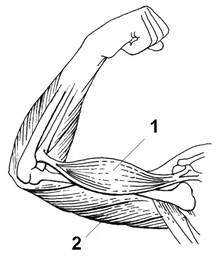
| Item |
Description |
1 |
Biceps brachii – a flexor |
2 |
Triceps brachii – an extensor |
Muscles work together to perform movements. Muscles that perform a particular movement together are agonists. Some muscles are prime movers, these muscles work with other muscles but they are the ones that exert the most force in a movement. The other muscles that help a prime mover is called asynergists.
Muscles that oppose or reverse a particular movement are antagonists. Because muscles work together, antagonist muscles can be prime movers also. For example, the triceps brachii, which performs extension of the elbow, is an antagonist to the biceps brachii. The biceps brachii performs flexion of the elbow as a prime movement, but extension of the elbow is also a prime movement. Refer to Figure 1.
|